
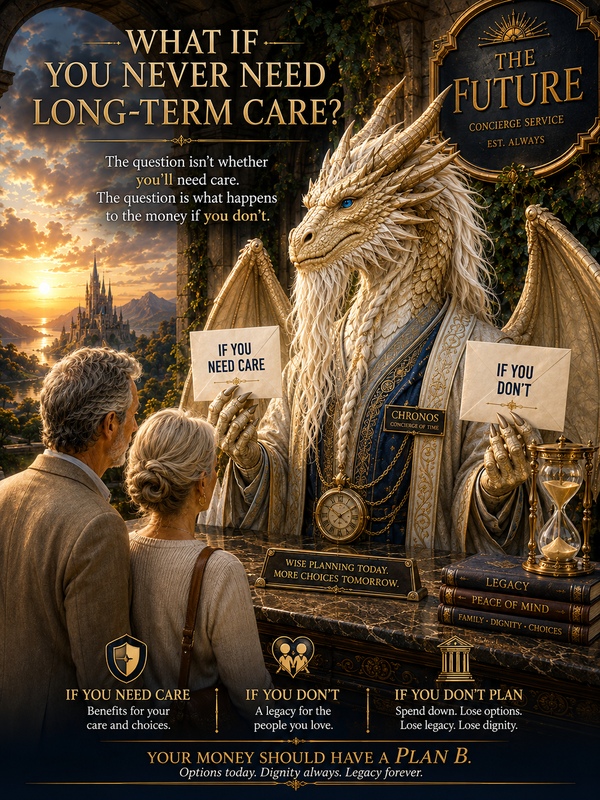
There is one objection to long-term care insurance that makes perfect sense to me:
“What if I pay for it for years and never need it?”
Exactly.
Nobody wants to spend thousands of dollars protecting against something they hope never happens—only to live a long, healthy life and never collect a dime.
But there's another possibility that deserves just as much attention:
What if you DO need long-term care—and you never planned for it?
Because at that point, somebody is going to pay.
The question is who.
Medicare Is Not Your Long-Term Care Plan
This surprises an astonishing number of people.
Medicare covers certain skilled nursing and rehabilitative care under specific circumstances. It does not provide open-ended coverage for the custodial care people commonly mean when they talk about long-term care—help with bathing, dressing, eating, toileting, transferring, supervision and the other activities that can become difficult as we age.
So when someone tells me:
“I have Medicare. I'm covered.”
My response is simple:
Not for this.
And that's where the conversation often turns to Medicaid.
“Then Medicaid Will Pay”
Maybe.
But there's an enormous difference between Medicare and Medicaid.
Medicaid is a needs-based program. To qualify for Medicaid long-term-care benefits, you generally must satisfy strict financial eligibility rules involving income and assets. Some assets may be exempt, and the exact rules vary by state and circumstance.
But the basic principle matters:
Medicaid isn't designed to preserve a comfortable retirement portfolio while the government picks up your long-term-care bill.
For many people, qualifying means spending down assets first.
Think about what that actually means.
You spent 40 years accumulating money.
You saved. You invested. You paid off the house. You built something you hoped would provide security for you and perhaps eventually become a legacy for your children.
Then you need care.
And suddenly those assets aren't your legacy anymore.
They're your long-term-care fund.
Spending Down Is a Plan
Technically.
So is doing nothing.
If your long-term-care strategy is, “I'll spend my own money until I qualify for Medicaid,” you have made a plan.
It's simply a plan that puts virtually all the financial risk on you.
And the cost isn't limited to dollars.
Money gives you choices.
It can affect whether care is provided at home or somewhere else. It can give your family more resources to help. It can expand the range of facilities and services available to you.
When you're healthy and independent, those distinctions may not seem terribly important.
When you can no longer bathe yourself, dress yourself or safely live alone, they can become extraordinarily important.
Money buys more than care. It buys options.
And when you're vulnerable, options can mean dignity.
The Cruel Little Paradox of Long-Term Care Insurance
There's another problem with the traditional approach.
Long-term care insurance is easiest to afford when you're younger and healthy—when long-term care is probably the last thing on your mind.
At 40 or 45, you're thinking about the mortgage, children, college, building a business and saving for retirement. Writing a check every month for something you might not need for another 30 or 40 years isn't exactly irresistible.
So most people wait.
Then somewhere in their 50s or 60s, long-term care suddenly starts looking very real. They've watched a parent decline. A friend has developed dementia. They've seen what several years of care can do to a family's finances.
Now they want the insurance.
Unfortunately, now they're older.
The premiums are higher.
And health matters. Waiting can mean paying substantially more—or discovering that a change in health makes coverage difficult or impossible to obtain.
That's the cruel little paradox:
When it's easiest to buy, you don't think you need it.
When you realize you need it, it may be expensive—or too late.
Maybe We're Asking the Wrong Question
Instead of asking a 45-year-old:
“Would you like to start paying for long-term care insurance you may never use?”
what if we asked:
“Would you like to start building an asset for your future that can also help pay for care if you eventually need it?”
Those are two very different propositions.
The second one gives younger people a reason to act before age and health start taking choices away.
What If Your Money Had a Plan B?
Certain life insurance policies can be designed with benefits that may provide access to money during your lifetime for qualifying long-term-care or chronic-illness needs.
If you need care, those benefits can provide another pool of money.
Instead of immediately reaching into retirement accounts, investments or other assets to pay every bill, you've created a resource specifically intended to help deal with the problem.
That can help protect the rest of your financial life—and preserve more choices about your care.
If You DON'T Need Care
Here's the part I particularly like.
Suppose you live a long, healthy life.
You never need years of long-term care.
Wonderful.
With the right life-insurance-based strategy, there is still a death benefit.
Somebody you love gets the money.
Instead of looking back at decades of premiums for coverage you never used, the strategy can still accomplish something important for your family.
That changes the question from:
“What if I never use it?”
to:
“Which benefit will I use?”
Care if I need it.
A legacy if I don't.
That's a very different conversation.
Your Legacy Isn't Just What You Leave Behind
We tend to think of “legacy” as the check somebody receives after we're gone.
I think that's too narrow.
Your legacy is also the freedom not to become financially dependent on your children.
It's the ability to tell your family what you want instead of asking them what they can afford.
It's giving your children permission to remain your children rather than automatically becoming your full-time caregivers.
It's having resources available when decisions become difficult.
And yes, it's also having something left after the bills are paid.
A long-term-care event can threaten all of those things.
There Are Really Three Envelopes
Imagine Chronos standing behind the desk at The Future.
The first envelope says:
IF YOU NEED CARE
There is money available to help provide it.
The second says:
IF YOU DON'T
There is still value for the people you love.
But there's actually a third envelope sitting under the counter:
IF YOU DON'T PLAN
Your savings become the plan.
Your investments become the plan.
Your retirement income becomes the plan.
Your family may become the plan.
And after sufficient spend-down, Medicaid may become the plan.
That envelope isn't nearly as attractive.
Long-Term Care Planning Isn't About Predicting the Future
I can't tell you whether you'll spend five years needing care.
Neither can anybody else.
That's precisely why we plan.
The goal isn't to predict which envelope you'll eventually open.
The goal is to make sure either outcome is financially survivable.
If you need care, you want resources.
If you don't need care, you'd probably rather have those dollars accomplish something else.
And if leaving a legacy matters to you, deliberately spending down your assets until a government program takes over probably isn't the legacy strategy you had in mind.
So perhaps the question isn't:
“What if I never need long-term care?”
Perhaps it's:
“What happens to my money either way?”
Because wouldn't it be nice if your money had a Plan B?