
For decades, employers have accepted a basic premise:
Providing good employee benefits means providing good health insurance.
But what happens when the cost of that health insurance becomes so enormous that it begins crowding out everything else an employer might do for an employee?
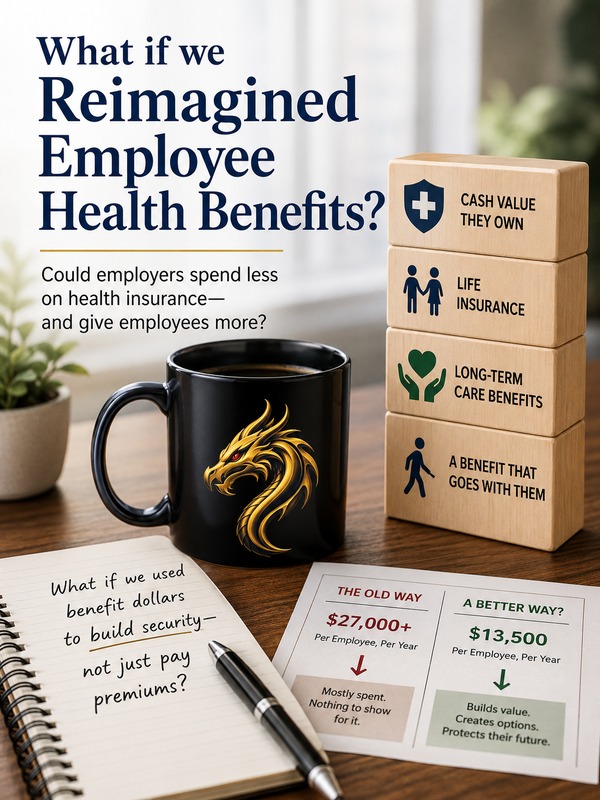
In 2025, the average annual premium for employer-sponsored family health coverage reached $26,993. Employees paid an average of $6,850 of that amount, with employers picking up the rest. Family premiums were up 6% in just one year and 53% since 2015.
That's almost $27,000 every year for one employee's family health insurance.
And paying the premium doesn't necessarily mean healthcare is free. Employees may still have deductibles, copays, coinsurance, prescription costs and other out-of-pocket expenses.
At some point, it seems reasonable to ask:
What are employers and employees actually getting in exchange for $27,000 a year?
And perhaps an even more interesting question:
What if we stopped assuming the only possible use for $27,000 was buying $27,000 worth of health insurance?
A Different Way to Think About the Money
Suppose we could reimagine the benefits package.
Not eliminate healthcare. Not pretend catastrophic medical expenses don't exist.
Simply rethink which tool should do which job.
For purposes of a thought experiment, let's start with that roughly $27,000 annual expenditure and ask:
What if we could cut the employer's benefit outlay roughly in half?
Now we have two buckets of approximately $13,500.
The employer keeps $13,500.
Instead of spending the other $13,500 on traditional group health insurance, the employer uses it to fund an individually owned permanent life insurance policy for the employee, designed for cash accumulation and including long-term-care benefits.
Meanwhile, employees obtain their own major-medical coverage in the individual market and may qualify for ACA premium subsidies based on their household circumstances.
For small employers, this is an especially interesting question. Employers with fewer than 50 full-time employees, including full-time equivalents, generally are not subject to the ACA employer shared-responsibility mandate. And when a job does not offer health insurance, an employee may purchase Marketplace coverage and may qualify for premium tax credits or other savings based on household income and eligibility.
Routine healthcare and other benefits could be addressed separately through properly structured benefit programs.
In other words, instead of asking one very expensive group health-insurance policy to solve every problem, use different tools for different problems.
So I Ran the Numbers
I wanted to know what the employee might actually receive if an employer redirected $13,500 per year into an individually owned life insurance policy.
I created a hypothetical 45-year-old female employee, preferred non-tobacco. The employer contributes $13,500 annually for 20 years.
That's a total employer outlay of:
$270,000.
Then the employer stops contributing.
The illustration was designed with a minimum non-MEC death benefit, indexed cash-value accumulation and a long-term-care rider.
At age 65, after total contributions of $270,000, the current illustrated assumptions show approximately:
$486,907 in net surrender value
$617,873 in death benefit
$251,459 in long-term-care benefits
The midpoint illustration shows $286,927 in surrender value and a $483,391 death benefit. Under the guaranteed assumptions, surrender value is $166,500 with a $396,080 death benefit.
The current illustrated cash-value result represents an internal rate of return of approximately 5.33% at age 65, after policy expenses.
And remember: the employer's contributions have now ended.
Five Years Later
At age 70, with no additional premiums paid after age 65, the current illustrated values have grown to approximately:
$671,612 in net surrender value
$779,069 in death benefit.
The employee also still has her long-term-care benefit. The illustration provides an initial maximum LTC benefit of approximately $5,029 per month, based on a $251,459 LTC rider amount.
The carrier's hypothetical LTC analysis assumes benefits begin at age 70. Under its current nonguaranteed assumptions, approximately $5,029 per month is paid until the illustrated LTC benefit is exhausted around age 75. Even after those illustrated LTC benefits, the policy shows approximately $675,798 in surrender value and $740,706 in death benefit at age 75.
That's when this stopped being merely an interesting insurance illustration to me.
It became a question about how employers allocate money.
Now Look at It From the Employer's Side
Our hypothetical employer used to have roughly $27,000 per year going toward the traditional healthcare-benefit model.
Under our thought experiment, the employer redirects $13,500 annually toward the employee's individually owned benefit.
And keeps approximately $13,500 per year that otherwise would have gone into the old benefits expenditure.
Over 20 years:
Employer contributions to the employee's policy: $270,000
Potential employer savings: another $270,000
That's $540,000 worth of economic decisions surrounding one employee over 20 years, even before considering future healthcare-cost increases.
Which raises the question I find much more interesting than whether one particular insurance product is “better” than another:
What did the employer and employee get for $540,000 under the old system — and what could they get if those same dollars were allocated differently?
What About Health Insurance?
This isn't an argument that people don't need protection against catastrophic medical expenses.
They do.
It's an argument that perhaps employment and major-medical insurance don't have to be joined at the hip.
An employee whose employer does not offer qualifying job-based health coverage can purchase individual Marketplace coverage and may qualify for subsidies based on household income and the applicable ACA rules.
That also gives employees something traditional group coverage doesn't always provide: choice.
Different employees have different families, doctors, medications, financial situations and risk tolerances. Why must the employer necessarily choose one health plan for all of them?
Perhaps the employer's job should be to provide valuable benefits — not necessarily to select everyone's health-insurance policy.
And What About Everyday Healthcare?
That's another piece worth reimagining.
Routine healthcare isn't the same financial problem as a catastrophic illness.
A $150 office visit isn't the same financial problem as a $500,000 cancer treatment.
A prescription isn't the same problem as a three-week hospitalization.
There are already benefit structures designed to address routine healthcare expenses, prescriptions, telehealth, navigation and other everyday needs without requiring the traditional group health plan to be the answer to everything.
The Section 125/105 program I've been examining, for example, includes reimbursement for eligible out-of-pocket medical expenses as well as virtual healthcare, prescription assistance and healthcare navigation.
That doesn't make it a substitute for major medical insurance.
It does suggest that we can stop thinking of employee healthcare as one monolithic problem requiring one monolithic solution.
There Are Questions to Solve
Of course there are.
Life insurance is individually underwritten. Not every employee will qualify, and age, tobacco use and health affect what a particular premium can purchase.
Employer benefit programs are subject to tax, ERISA, nondiscrimination and other rules. An actual program would need to be designed with the appropriate benefits, legal and tax professionals.
And indexed universal life illustrations contain both guaranteed and nonguaranteed values. The 6.47% values used in this illustration are not predictions of future performance. Actual results may be more or less favorable, and additional premiums could be required if policy performance differs from the assumptions.
Under the guaranteed assumptions in this particular illustration, the policy ultimately lapses at age 82; under the midpoint and current illustrated assumptions, coverage continues through age 120.
Those are real considerations.
But they don't invalidate the question.
Maybe It's Time to Ask a Different Question
For years, businesses have responded to rising health-insurance costs by changing deductibles, changing carriers, changing networks, increasing employee contributions or simply absorbing another increase.
Maybe we're rearranging the furniture when we should be reconsidering the house.
What if a small employer could substantially reduce what it spends on traditional health benefits?
What if employees could choose their own major-medical coverage and receive whatever ACA assistance they're legally entitled to?
What if everyday healthcare needs were addressed separately?
And what if part of the money currently disappearing into annual health-insurance premiums instead created an asset owned by the employee — providing cash value, life insurance and long-term-care protection?
All while reducing the employer's overall benefit expenditure?
I don't pretend we've answered every question.
But with family health-insurance premiums approaching $27,000 a year, I think we've reached the point where employers should at least be willing to ask one:
What if we reimagined the whole thing?
KFF, 2025 Employer Health Benefits Survey
IRS, Determining if an Employer is an Applicable Large Employer
HealthCare.gov, Marketplace coverage and job-based coverage