
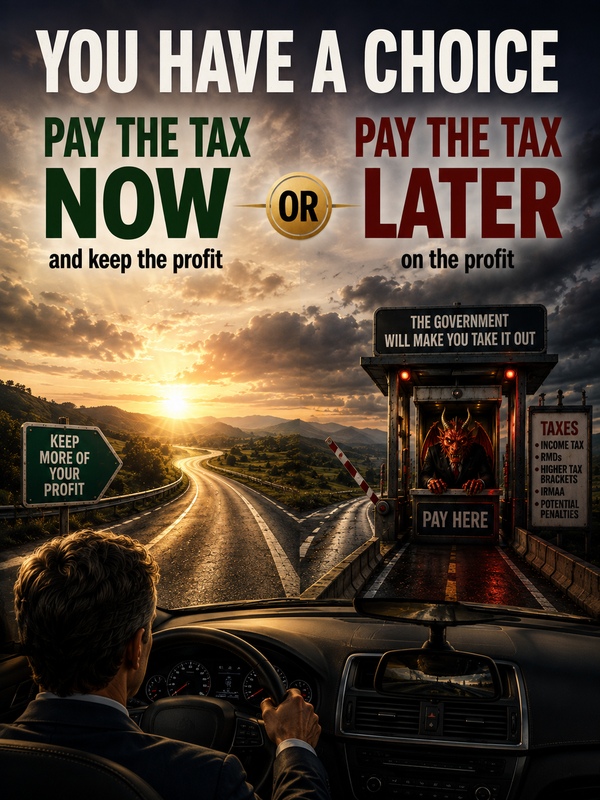
There are plenty of things about retirement you can't control.
Future tax rates. Inflation. Markets. How long you'll live. What healthcare will cost.
But there is one decision you may have more control over than you think:
When do you want to pay the tax?
The Deal Most Americans Were Given
For decades, the retirement message has been remarkably consistent:
Put money into a tax-deferred retirement account today. Save the tax now. Pay it later.
That can sound terrific. Who wouldn't rather postpone a tax bill?
But “later” isn't the same thing as “never.”
With traditional tax-deferred retirement accounts, the tax bill has simply been moved into the future. When the money comes out, distributions are generally taxable as ordinary income.
And eventually, with many tax-deferred accounts, the government doesn't merely allow you to take the money out. It requires you to begin taking it out through Required Minimum Distributions.
So What Exactly Did You Defer?
Suppose you earn money today and place some of it into a traditional tax-deferred retirement account.
You receive the tax benefit today. The money grows without current income tax inside the account.
Years later, you begin taking distributions.
Now you're paying tax at the tax rates that exist then—on money you may be required to withdraw whether you need it or not.
That's the bargain.
Pay the tax later on the money you take out.
But There Is Another Choice
What if you deliberately paid the tax now?
Now the money is yours after tax.
The next question becomes much more interesting:
Where can you put those after-tax dollars so the future growth doesn't simply create another stream of taxable retirement income?
That's where tax-free retirement strategies enter the conversation.
Roth Is One Answer. It Isn't the Only One.
A Roth account is the familiar example. You contribute after-tax dollars, and qualified distributions can be tax-free.
But for some people—particularly successful business owners and higher-income earners—the amount they want to reposition for retirement may be much larger than what a Roth strategy alone can accommodate.
That's when properly designed permanent life insurance can become worth examining.
Life Insurance Isn't Just About Dying
Most people still think of life insurance as money for somebody else after they're gone.
But certain permanent life insurance policies are designed to build cash value during your lifetime.
They are funded with after-tax dollars. There is no deduction for putting the money in.
That's important.
You paid the tax now.
When a policy is properly designed, funded and managed, cash value can grow tax-deferred, and money may be accessed through withdrawals and policy loans in a way designed to provide tax-free retirement income.
There are no Required Minimum Distributions forcing you to take money simply because you've reached a particular age.
Now Look at the Two Roads
Road One: Take the tax benefit today. Allow the money to grow tax-deferred. Take taxable distributions later, with RMD rules eventually determining that at least some of the money must come out.
Road Two: Pay the tax today. Position after-tax dollars in a strategy designed to build value that can be accessed tax-free later.
Neither road makes taxes magically disappear.
The difference is when you pay the tax—and who gets to keep the profit afterward.
Why This Can Matter More Than It Looks
Taxable retirement distributions don't necessarily exist in isolation.
Additional taxable income can affect how much of your Social Security is subject to federal income tax. It can also affect Medicare income-related surcharges for higher-income beneficiaries.
So the question isn't merely, “How much money did I save?”
A better question may be:
How much of my retirement income will actually be mine to spend?
The Government Has a Retirement Plan for Your Money
If you've accumulated a substantial amount in traditional tax-deferred retirement accounts, at some point the government has rules about when distributions must begin.
You may not need the money.
You may not want the additional taxable income.
But the distribution can still be required.
That's why retirement planning should involve more than accumulating the largest possible account balance.
It should also involve deciding what kind of income you want that account to produce.
So Which Tax Bill Would You Rather Own?
Nobody knows exactly what federal tax rates will be 10, 20 or 30 years from now.
But we do know what the rules are today.
And that gives you a choice.
Pay the tax now and position the profit for tax-free retirement income.
Or defer the tax and pay it later when the money comes out.
The right answer depends on your situation.
But “I'll worry about the taxes when I retire” isn't much of a strategy.
You have a choice. It's worth making it deliberately.