
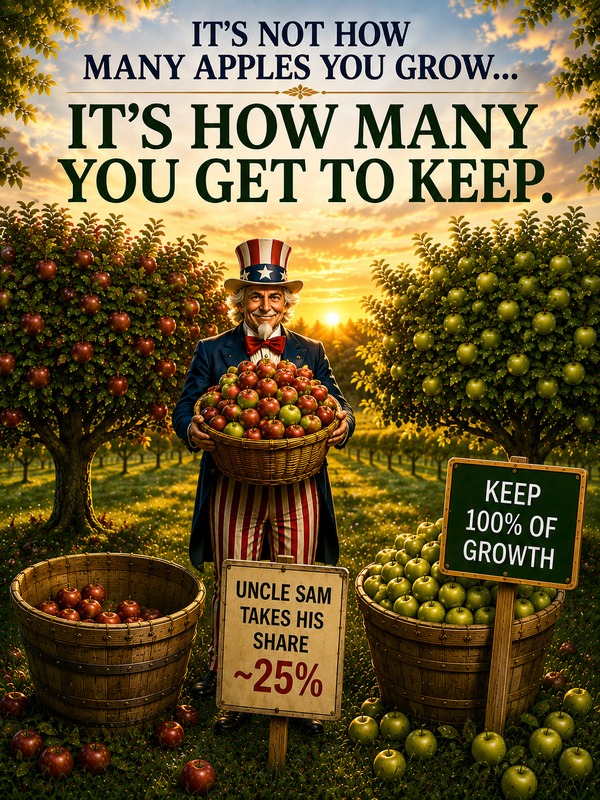
Suppose two people each arrive at retirement with the same account balance. Are they equally wealthy?
Not necessarily.
One may own money that will be taxable when withdrawn. Another may have money available under different tax rules. The number at the top of the statement can be identical while the amount available to spend is very different.
The orchard problem
Think of retirement savings as an orchard. Growing more apples is good. But if part of the harvest belongs to someone else, you should not plan your dinner around the gross harvest.
Traditional 401(k), 403(b) and IRA distributions are generally taxable to the extent they contain untaxed money. The exact tax cost depends on your tax bracket when the money comes out.
The “25%” on the tile is an illustration, not a universal tax rate. Your rate could be lower or higher.
Tax diversification matters
This is why retirement planning should track more than total assets. I want to know which dollars are taxable, which are tax-deferred, which may be tax-free when rules are satisfied, and which may receive different treatment when passed to heirs.
Roth accounts, taxable brokerage assets, traditional retirement accounts, life insurance, annuities and other assets do not all follow the same tax rules.
The goal is not necessarily to pay zero tax. The goal is to avoid discovering too late that the retirement balance you celebrated was never entirely yours to spend.
Grow the apples. Then build a plan for keeping as much of the harvest as legally possible.
Source: IRS: RMD and Retirement Distribution FAQs.