
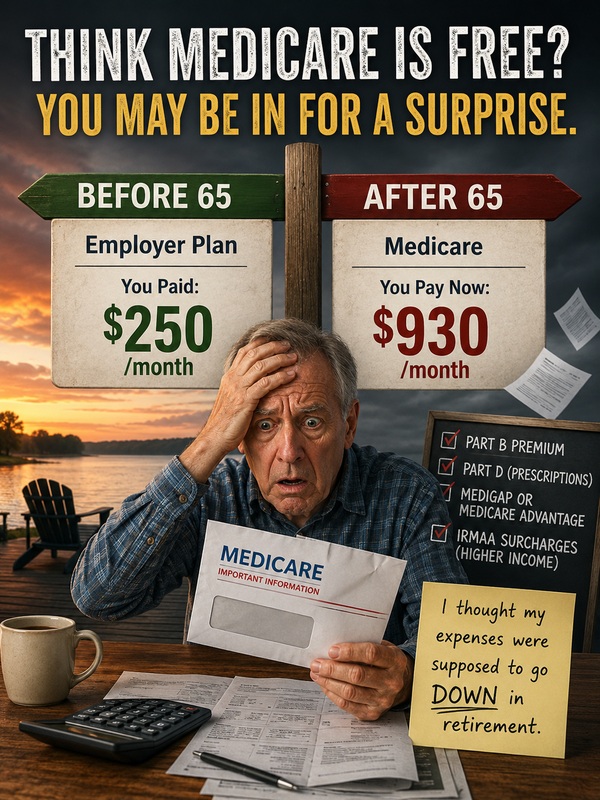
One of the most persistent assumptions about retirement is that expenses will automatically go down.
No commute. No work clothes. Maybe the mortgage is paid off. And once you turn 65, Medicare takes care of health insurance.
Except Medicare isn't free.
For some retirees, the transition from employer-sponsored health insurance to Medicare can produce an unpleasant surprise—especially when the amount they remember paying at work was only their share of a plan that their employer was helping to subsidize.
The employer subsidy disappears
While you're working, you may see a few hundred dollars disappearing from your paycheck every month for health insurance. What you may not see nearly as clearly is how much your employer is paying on your behalf.
When employment ends, that subsidy may end with it. Medicare then brings its own set of premiums and potential out-of-pocket costs.
Medicare has costs of its own
In 2026, the standard Medicare Part B premium is $202.90 per month. Part D prescription drug premiums vary by plan. Medicare Advantage costs also vary by plan, and people who choose Original Medicare may purchase a Medicare Supplement (Medigap) policy, whose premium varies by policy, location and other factors.
Most people receive premium-free Part A because they or a spouse paid Medicare taxes long enough while working, but Medicare coverage is not the same thing as free health care.
And then there's IRMAA
Higher-income Medicare beneficiaries can pay an additional amount for Part B and Part D called the Income-Related Monthly Adjustment Amount (IRMAA).
For 2026, IRMAA begins when 2024 modified adjusted gross income exceeds $109,000 for an individual or $218,000 for a married couple filing jointly. At the highest 2026 income tier, the total Part B premium alone is $689.90 per person, per month, before any Part D premium, Part D IRMAA or other coverage costs.
Why retirement planning and Medicare planning collide
Medicare generally uses modified adjusted gross income from your federal tax return from two years earlier to determine whether IRMAA applies.
That means decisions about where retirement income comes from can affect more than the income-tax bill. Taxable retirement distributions, Roth conversions and investment income can potentially affect modified adjusted gross income and therefore Medicare premiums.
IRMAA can sometimes be reconsidered after certain life-changing events when income falls, but retirement itself does not guarantee that the surcharge disappears. Someone who continues to have substantial taxable or investment income may remain above an IRMAA threshold.
That's one reason Medicare planning shouldn't begin a few weeks before your 65th birthday. It belongs in the retirement conversation earlier.
“But I'll spend less when I retire.”
Maybe. But retirement has an irritating habit of coming with things you finally have time to spend money on: travel, grandchildren, hobbies, home improvements—and health care.
The objective of retirement planning shouldn't simply be accumulating the largest possible account balance. It should include understanding how income, taxes and health-care costs interact once the paycheck stops.
Before you retire, ask four questions
1. What will my health coverage actually cost after I leave my employer?
2. Could my retirement income expose me to IRMAA?
3. Which of my retirement income sources will increase my taxable income?
4. Do I have enough flexibility to control where my income comes from each year?
Turning 65 doesn't automatically make health care cheap. Discovering that after you've retired is a particularly unpleasant way to learn it.
Sources: Medicare.gov: Medicare Costs; CMS: 2026 Medicare Parts A & B Premiums and Deductibles; Medicare & You 2026.